Personal project
Financial Control Center
- Next.js
- TypeScript
- Prisma
- PostgreSQL
- Better Auth
- Vitest
Problem
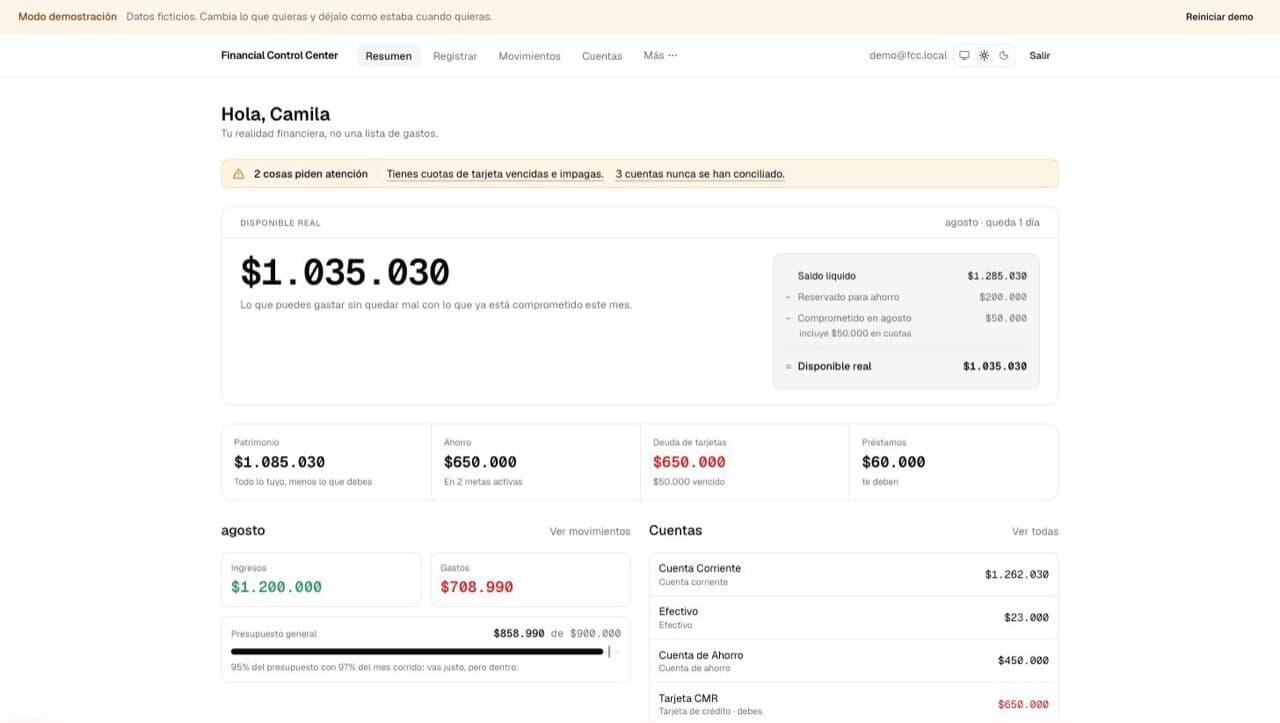
A bank balance does not tell you what you can spend: it ignores commitments, debt, reserved savings and planned transactions. The product turns those rules into an honest financial picture.
Context
A personal project: it started as a way to solve a problem of my own, and I designed and built it from scratch. It is still in development. The repository contains a working application, demo data, architecture documentation and financial-invariant tests against real PostgreSQL.
Objective
Build a control center that explains real available money, records operations without rewriting history and lets the domain evolve incrementally.
My role
- Defined the product, domain language, visual experience and full-stack architecture.
- Modeled the domain in Prisma (23 models and 17 enums), documenting which constraints belong in the database and which belong in business logic.
- Implemented authentication, persistence, use cases, responsive UI, demo data and automated tests.
Architecture & decisions
- Next.js 16 with Server Components and Server Actions; PostgreSQL is the source of truth and Prisma is the persistence layer.
- Better Auth shares the domain User and renames its Account model to avoid colliding with a financial account.
- Multi-entity writes run in transactions; Zod validates rules PostgreSQL cannot express.
- 23 ADRs record decisions around domain, security, authentication, state, theming and testing.
Architecture flow
- 01UI + forms
- 02Use cases + Zod
- 03Prisma + transactions
- 04PostgreSQL
Solution
- Implemented: accounts, transactions, credit and installments, planning, budgets, savings, loans, reconciliation, rules, overview and analysis.
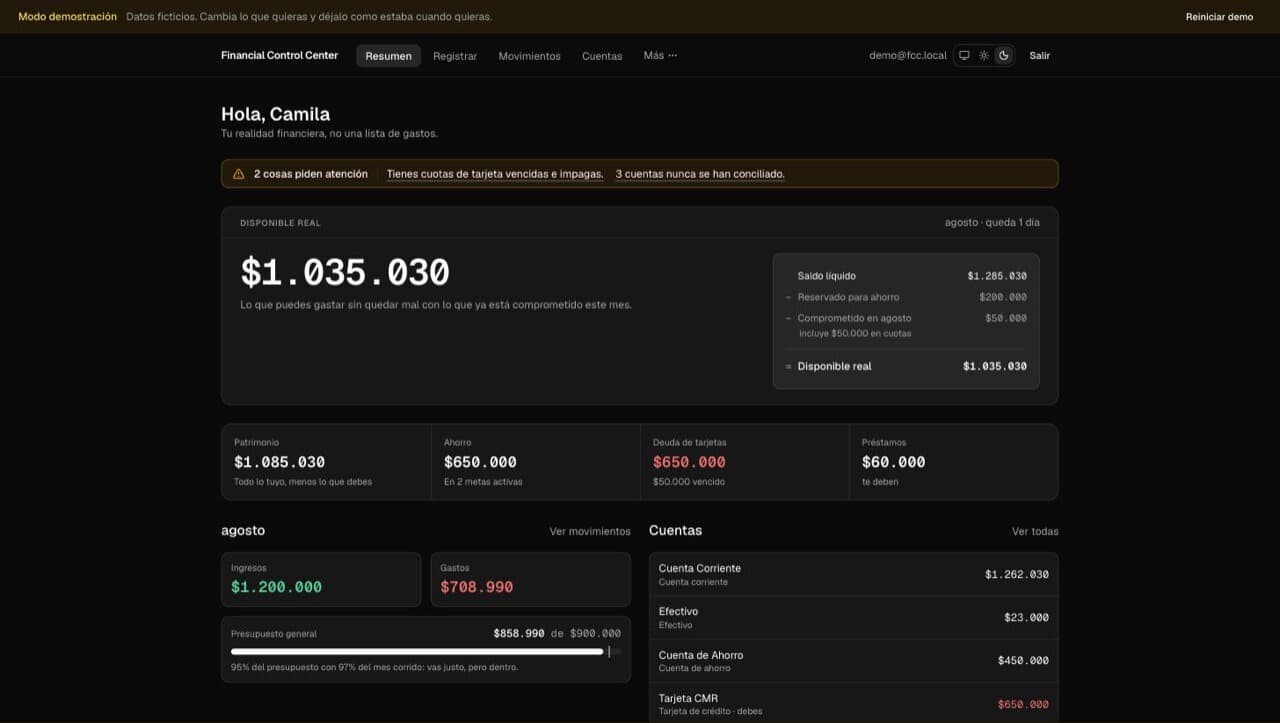
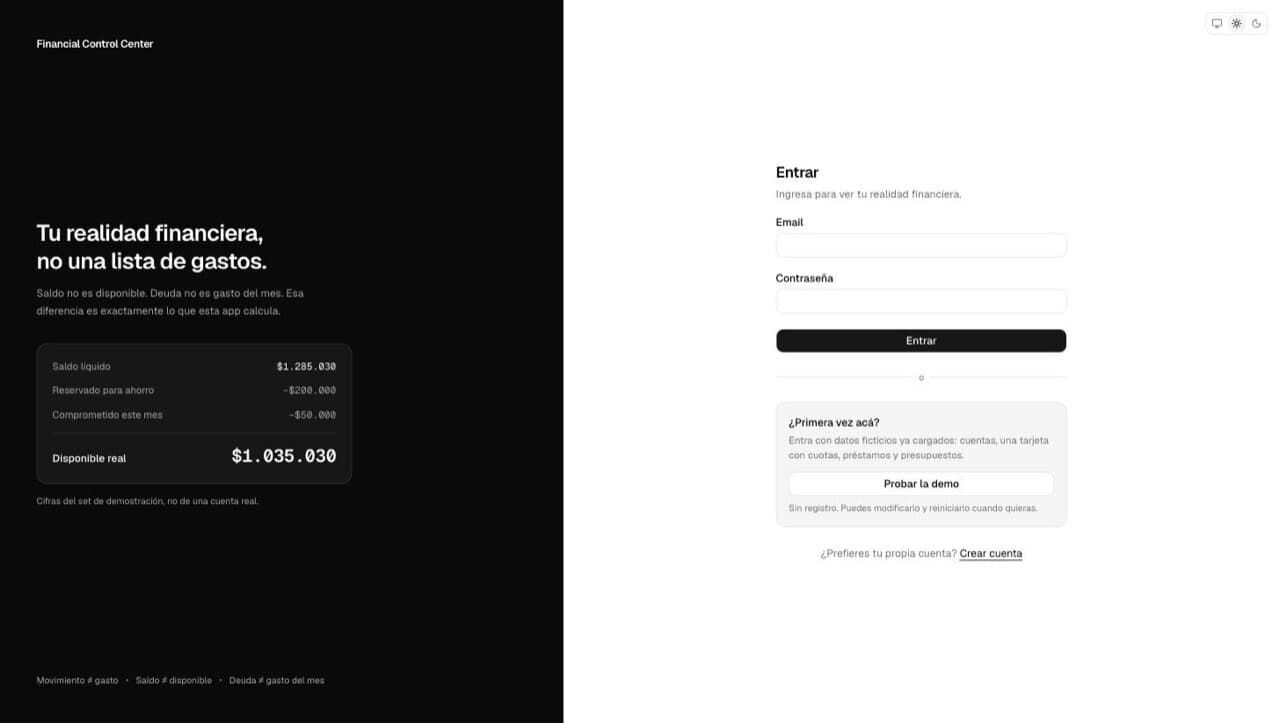
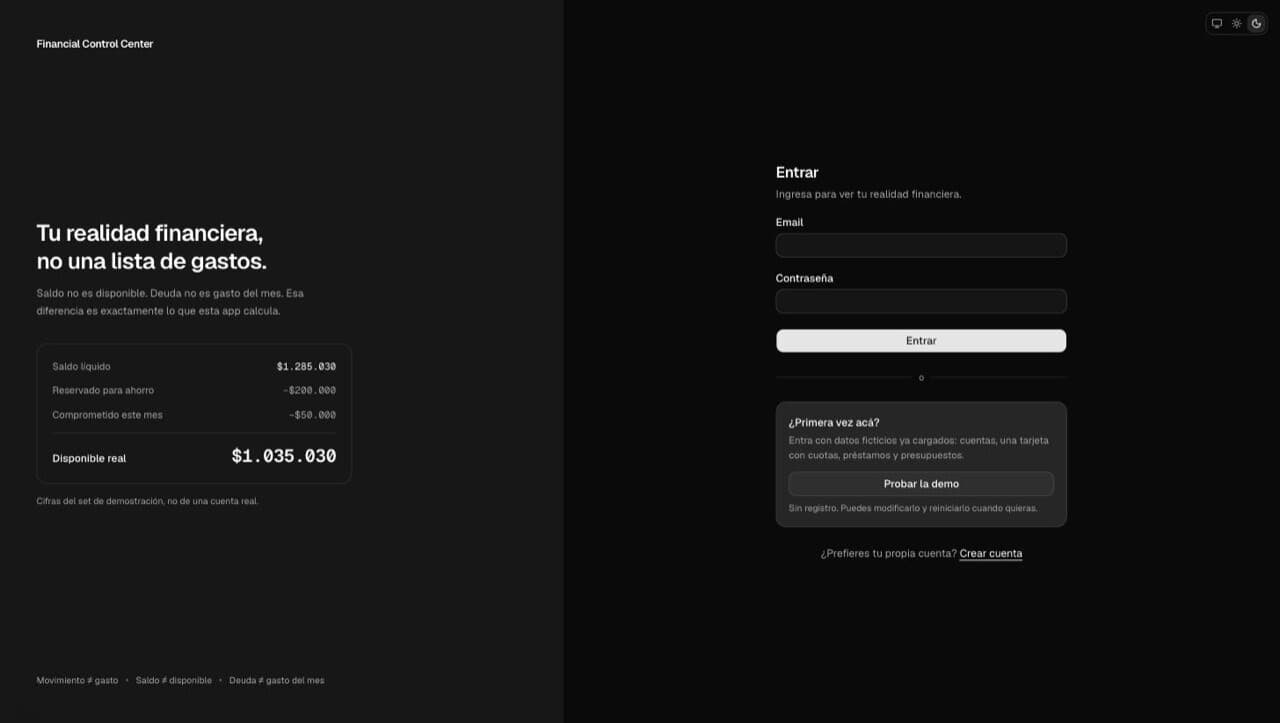
- Implemented: quick entry, light/dark/system themes, deterministic demo data and per-user data isolation.
- In development: public deployment and refinement of complete flows with real-world data.
- Planned: natural-language transaction entry as a layer over validated use cases, never as direct database writes.
Challenges & trade-offs
- Distinguishing balance, available money, debt, spending, savings and reimbursements without duplicating sources of truth.
- Keeping an auditable history: transactions are voided instead of deleted and time-sensitive values are derived on read.
- Prioritizing domain correctness over premature abstractions; V1 adds neither a generic repository layer nor global state.
Views
Screenshots from the live site
Learnings
- Domain modeling and invariants shape the product more than any isolated screen.
- Testing financial rules against real PostgreSQL catches failures a mock cannot represent.
- ADRs make the engineering process visible and let decisions be revisited as the product grows.
Result
A working application in development with authentication, a complete financial domain, responsive UI and a test suite. Production infrastructure is documented; public deployment is still pending.